AI Agents in Hospitality Applications: Use Cases, Benefits & How to Build Right
- Trinankur Bera

- Travel and Hospitality
- Last updated on
Key Takeaways
The hospitality industry is adopting AI agents to handle rising guest expectations, staffing shortages, and the need for 24/7 service.
AI agents automate guest communication, bookings, pricing, housekeeping, and back-office tasks while integrating with systems like PMS, CRM, and booking engines.
Real-world brands such as Wyndham, Airbnb, HomeToGo, and Expedia already use AI agents to speed up support, personalize experiences, and improve efficiency.
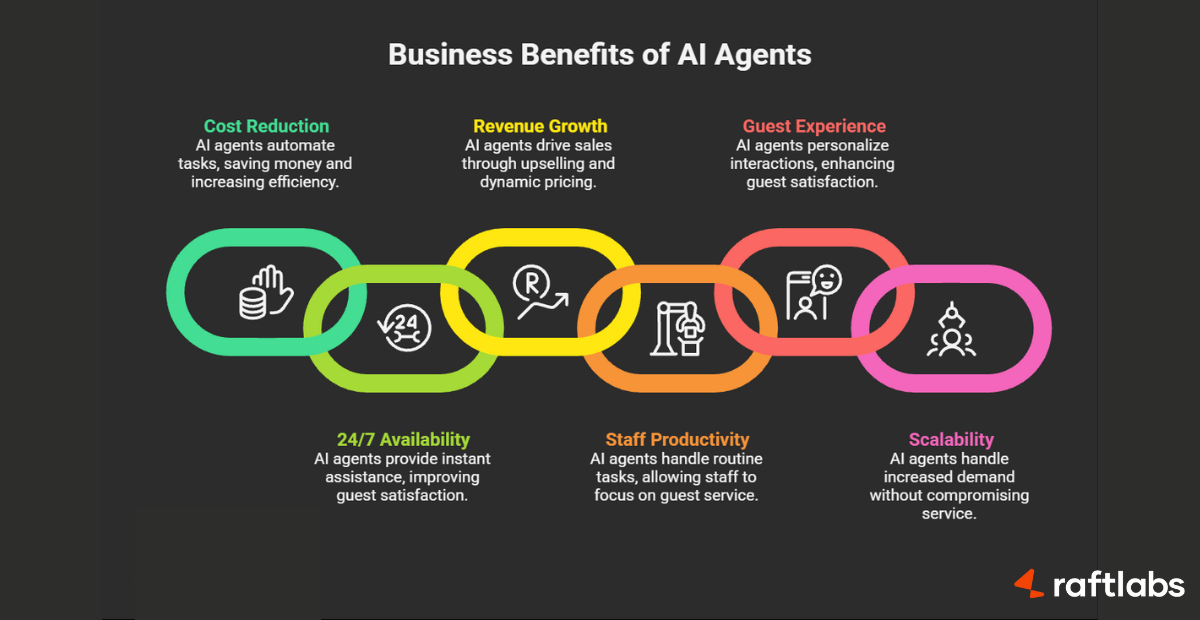
Key benefits include faster responses, higher guest satisfaction, better revenue optimization, reduced manual workload, and data-driven decision-making.
Main challenges include data privacy, system integration with legacy tools, staff training, guest acceptance, and risks such as AI bias and hallucinations.
Successful implementation requires identifying high-impact use cases, choosing build vs buy, selecting suitable AI models, integrating with core systems, piloting, and tracking metrics.
The future of AI in hospitality points to more autonomous, proactive agents that connect all hotel systems, personalize in real time, and support sustainability and energy savings.
Human staff will not be replaced but supported, with AI taking over repetitive tasks so teams can focus on high-value, personal guest interactions.
Specialized partners like us offer rapid prototyping, end-to-end development, secure integrations, and ongoing support to build scalable, custom AI agents for hospitality.
The hospitality industry is facing a critical turning point, where rising guest expectations and operational challenges require innovative solutions. With staffing shortages and the need for 24/7 guest support, businesses are turning to AI agents in hospitality applications to bridge the gap between service quality and operational efficiency.
A Cisco report on agentic AI forecasts that by 2028, AI could handle up to 68% of customer interactions across industries. In hospitality, these AI-powered agents, built using artificial intelligence, natural language processing (NLP), and machine learning, are already improving guest experience personalization, response times, and backend operational efficiency.
In this guide, we’ll explore how AI agents are reshaping the hospitality industry, their real-world use cases and benefits across hotels and travel businesses, and the impact they’ll have on the future of hospitality operations and customer experience.
Who Is This Guide For?
This guide is for:
Hotel owners, managers, and operators looking to enhance guest services through AI-driven automation.
Property managers and vacation rental businesses exploring ways to improve efficiency and streamline guest interactions.
Hospitality tech leaders and product managers evaluating AI tools to improve operational workflows and guest experiences.
Customer service teams seeking innovative solutions to handle increasing guest inquiries and provide 24/7 support.
Marketing teams in the hospitality industry looking to leverage AI for personalized guest engagement and promotions.
Industry professionals in luxury hotels, resorts, and boutique properties interested in elevating guest experiences through AI automation.
Anyone asking: How can AI agents help transform my hospitality business and improve service without compromising on the human touch?
What This Guide Will Cover
This guide provides a comprehensive look at AI agents in the hospitality industry, structured to help hotel owners, hospitality operators, and technology decision-makers quickly grasp the key concepts and practical insights:
AI Agent Use Cases: Explore the various ways AI agents are transforming hospitality, and reservations to enhancing hotel operations and internal workflows, with specific examples from real-world hospitality businesses.
Benefits and Impact: Understand how AI-powered agents drive operational efficiency, cost optimization, revenue growth, and elevate guest satisfaction and personalized experiences across hotels and travel brands.
Challenges in Implementation: Learn about the potential hurdles when integrating AI agents with existing hospitality systems such as PMS, CRM, and booking engines, including data privacy, security, and system interoperability, and how to overcome them.
Future Trends and Opportunities: Discover the role agentic AI will play in the future of hospitality, including autonomous guest services, predictive personalization, and AI-driven decision-making.
Step-by-Step Implementation Guide: Practical guidance on how to implement AI agents in hospitality, from identifying automation opportunities to system integration, testing, deployment, and scaling.
Vendor Selection and Customization: Guidance on choosing between off-the-shelf AI solutions and developing a custom AI agent tailored to your hospitality workflows, guest experience goals, and operational requirements.
Now that you know what this guide will cover, let’s take a closer look at what AI agents are, how they work, and why they are transforming the hospitality industry.
What Are AI Agents in Hospitality?
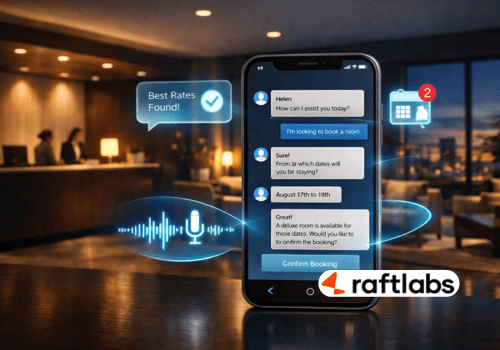
AI agents in hospitality applications are smart intelligent digital assistants designed to improve hotel operations and enhance the guest experience. They automate routine tasks such as booking confirmations, reservation management, and answering common guest queries, allowing hotel staff to focus on more complex, high-value, and personalized services.
For example, when a guest makes a reservation, an AI agent in hospitality can automatically confirm the booking, suggest room upgrades or add-on services, and recommend local attractions or experiences based on the guest’s preferences, booking history, or past visits.
AI agents can also assist with digital check-ins, offering mobile key access, self-service kiosks, or contactless check-in options that reduce wait times and improve operational efficiency.
These AI systems use technologies such as artificial intelligence (AI), Natural Language Processing (NLP), and machine learning to understand guest intent and respond to requests in real time, delivering human-like conversations and contextual recommendations.
AI agents also integrate seamlessly with existing hotel management systems, ensuring smooth adoption without disrupting daily operations, including:
Property Management Systems (PMS)
Customer Relationship Management (CRM) Tools
Hotel Booking Engines
Channel Managers
This integration helps AI agents improve workflows and improve data-driven decision-making, and elevate service quality across the guest journey without replacing existing infrastructure.
Now, let’s dive deeper into the reasons behind the rapid adoption of AI agents by hospitality companies.
Check out our AI development services to build your tailored AI agents for your hospitality business.
AI Agents vs Chatbots: A Real-World Example
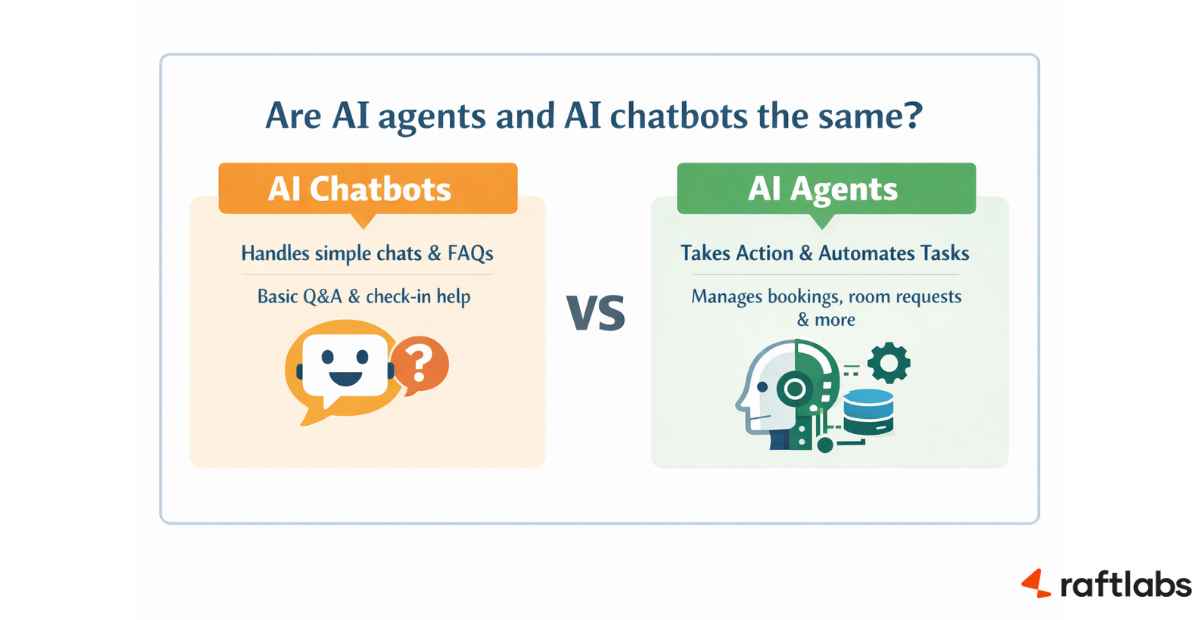
Most hoteliers hear "AI agent" and picture a chatbot with a fancier interface. They're not the same thing — and the difference matters when you're deciding what to build.
A chatbot follows a script. You ask it something outside the script, it fails. It responds. It does not act.
An AI agent understands intent, makes decisions, and takes action across multiple systems, without a human in the loop.
Here's how the same guest request plays out with each:
Guest message: "Can I check in early? I'm arriving at 10am."
Chatbot response: "Check-in is available from 3:00 PM. Please contact reception for early check-in requests."
AI agent response: Reads the message, checks room availability in the PMS, sees that the room is clean and unoccupied, confirms the early check-in automatically, sends the guest a confirmation with their digital room key — all in under 30 seconds, with no staff involvement.
That's the operational gap these tools close. Not "smarter replies." Actual tasks, completed autonomously.
This distinction matters even more when you think about the guest journey as a whole. A single stay involves booking, pre-arrival communication, check-in, in-stay requests, housekeeping coordination, upselling, checkout, and post-stay follow-up. A chatbot handles one of those touchpoints reactively. An AI agent in hospitality applications can handle the entire arc proactively.
Types of AI Agents (and How Each Maps to Hospitality)
Not all AI agents work the same way. Knowing the types helps you pick the right setup for the job you want to automate.
1. Reflex Agents
These act only on current input. They do not use memory or reasoning.
Example rule: "If room is marked dirty → alert housekeeping."
Hospitality use: Automated status updates between housekeeping and the front desk.
2. Model-Based Agents
Use memory to factor in context before acting. They maintain an internal model of what's happening.
Hospitality use: A check-in agent that knows a guest's preferences from previous stays and adjusts the room setup accordingly before arrival.
3. Goal-Based Agents
These plan steps to reach a specific outcome. They focus on what needs to be done to achieve a goal.
Hospitality use: A booking assistant that increases direct bookings. It compares channels, applies pricing rules, and guides the guest through the lowest commission option without staff help.
4. Utility-Based Agents
These compare different outcomes and pick the best one. They are often used for pricing and revenue decisions.
Hospitality use: A Revenue Management System (RMS) integrated agent that looks at competitor rates, local demand, and past data to set the best room price. It keeps adjusting as things change.
5. Learning Agents
These improve over time using feedback. They get better with every interaction.
Hospitality use: A guest communication agent that learns which upsell offers work best for different guest types and adjusts messages on its own.
Most real-world hospitality AI systems use a mix of these agents. One agent handles guest communication. Another manages pricing. Another controls the booking flow. Together, they work as a multi-agent system, which we explain in the use cases section below.
Why Hospitality Businesses Are Adopting AI Agents Now
The numbers behind this shift are hard to ignore.
According to the American Hotel & Lodging Association, 76% of surveyed hotels report staffing shortages. At the same time, guest expectations have risen sharply. Today's travellers benchmark a hotel's digital experience not just against other hotels, but against the instant, frictionless service they get from Amazon and Uber.
The operational math is straightforward: you can't hire your way out of this. The cost of a senior operations hire in most markets is north of £60,000 per year. Three months to recruit, six months to onboard. And even with a full team, consistency across the guest journey is nearly impossible to guarantee at scale.
AI agents in hospitality applications don't replace your team. They handle the repeatable, time-sensitive, system-dependent work, so your team can focus on the moments guests actually remember.
Thus, hospitality companies are turning to AI agents not just because the technology exists, but because the business environment and guest demands have shifted fast in recent years.
Guests and operations teams alike are looking for smarter, faster, and more consistent service, and AI agents are one of the strongest tools available today.
1. Rising Guest Expectations
Modern travelers want service that feels timely and tailored to them. They expect quick replies to booking questions, smooth contactless interactions, and suggestions that fit their preferences without having to repeat themselves.
A hospitality tech report shows that 70% of guests prefer using AI‑powered chatbots for simple questions like Wi‑Fi passwords or check‑in info, indicating strong guest openness to AI agents.
2. Staff Shortages
The industry still struggles with labor gaps. According to a survey by AHLA, about 65% of surveyed hotels report staffing shortages, with key roles like housekeeping and front desk still hard to fill.
AI agents assist by handling similar repetitive tasks like answering routine inquiries and coordinating housekeeping, allowing human staff to focus on more meaningful guest interactions.
3. Need for 24/7 Operations
Guests don’t operate on a 9-to-5 schedule, and neither does their need for help. AI agents can answer questions, update reservations, or provide information at any hour, ensuring guests always have support even when staff are off shift.
4. Pressure on Margins
Hotels constantly look for ways to cut costs and operate efficiently. AI can automate routine processes like reservation confirmations and post‑stay feedback collection, helping properties reduce manual workload and support more with less.
This support becomes even more valuable when budgets are tight and pricing competition is high.
5. Digital‑First Travelers
More travelers now prefer booking and service experiences that are mobile, contactless, and data‑driven. Guests like being able to check in through a phone app, get real‑time updates, or make requests instantly without waiting in line.
AI agents make these digital, convenience‑focused experiences smoother and more reliable.
As AI agents continue to address operational challenges and meet growing guest expectations, their practical applications are expanding across various areas of hospitality, delivering tangible benefits in guest service, revenue optimization, and more.
Check out our travel and hospitality development services to build the hospitality product.
Key Use Cases of AI Agents in the Hospitality Industry
AI agents are becoming a natural part of how modern hospitality teams work. Below are some of the most helpful ways hospitality businesses are using AI agents today.
1. AI Agents for Guest Communication & Support
For hotel staff or vacation rental managers, responding to guest inquiries 24/7 can be overwhelming, especially during peak seasons. Whether it is a question about TV settings or requests for restaurant reservations, guests expect quick and personalized responses.
AI agents can handle these routine inquiries at any time, freeing up your staff to focus on more complex issues.
Imagine running a resort where guests can instantly chat with an AI assistant to get local recommendations, make dining reservations, or get answers to frequently asked questions without needing to wait for a human to become available.
2. AI Agents for Bookings & Reservations
Managing bookings can be a nightmare, especially for property managers during high-demand periods. With multiple channels to monitor and constant guest requests, staying on top of it all can be exhausting.
AI agents integrate seamlessly with your Property Management System (PMS) and booking engine to automate the reservation process. They can manage real-time availability, offer personalized room upgrades, and even handle booking modifications.
Whether you are managing a busy hotel, a vacation rental, or a boutique property, AI agents ensure that your reservation system is running smoothly, reducing manual errors and freeing your team to focus on guest satisfaction.
3. AI Agents for Revenue & Pricing Optimization
In a highly competitive market, pricing strategy is crucial to maximizing revenue. For hoteliers and property managers, keeping up with fluctuations in demand and competitor pricing can be time-consuming. AI agents use real-time data to dynamically adjust room rates based on occupancy, competitor prices, and market trends.
For instance, imagine a vacation rental manager who can easily optimize rental prices during a local rock concert without constantly checking rates across platforms. AI ensures that pricing is always competitive, helping to maximize occupancy even during off-peak seasons.
4. AI Agents for Operations & Housekeeping
Running a smooth operation means keeping things running behind the scenes, especially when it comes to housekeeping. In larger properties with high guest turnover, keeping track of room cleaning schedules can be a logistical nightmare.
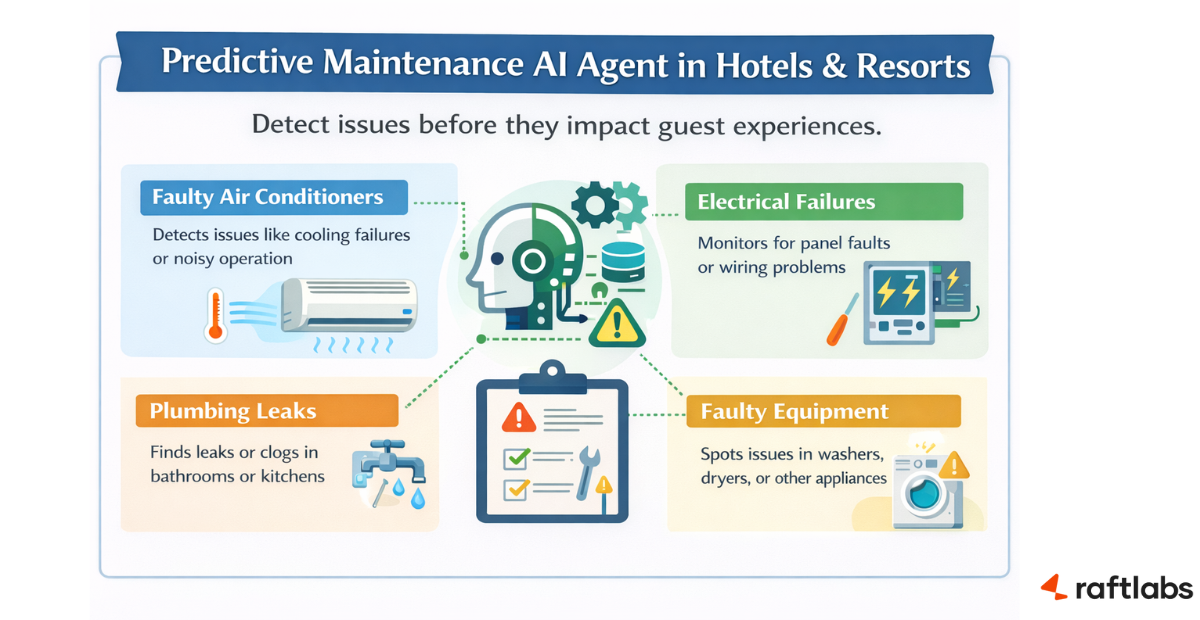
AI agents can automate housekeeping management by optimizing schedules based on guest preferences and room occupancy. Furthermore, predictive maintenance AI agents can spot potential issues before it impacts the guest experience.
5. AI Agents for Personalized Guest Experience
Guest expectations have changed. Today’s travelers expect personalization, even before they arrive. For hotel managers or resort staff, offering customized experiences for each guest might seem like a challenge, but it is now easier than ever with AI agents.
For instance, imagine a guest who regularly requests a particular type of pillow. AI can suggest this specific pillow for their next stay, showing them you have paid attention.
6. AI Agents for Back-Office Automation
Hotel staff, property managers, and resort teams juggle a lot of administrative tasks, from invoicing and inventory management to financial reporting. With limited time and resources, these behind-the-scenes tasks can easily pile up.
AI agents can automate much of this work, ensuring that financial records, inventory checks, and other tasks are handled accurately and efficiently.
As AI agents enhance various operational aspects of hospitality, they also bring measurable business benefits that go beyond just automation, helping brands reduce costs and empower revenue growth.
7. RMS-Integrated Revenue Agents
One of the highest-value applications of AI agents in hospitality is in revenue management, specifically integrating an autonomous pricing agent with your Revenue Management System (RMS).
A revenue agent monitors competitor pricing, local event calendars, and real-time booking velocity. It adjusts your nightly rates automatically, within rules you define, without requiring a revenue manager to log in and manually update rates across every channel.
We saw this play out directly with a serviced apartment operator. Their booking flow was broken — guests were being redirected to an external RMS page mid-booking, which damaged trust and weakened brand recall. After rebuilding the experience with a native direct booking engine and RMS Cloud integration, direct bookings increased, contributing to a 25% rise in direct revenue.
That's not an AI agent in the classical sense. It's the groundwork that makes one possible. The lesson: before you build an AI agent, your systems need to talk to each other. PMS, RMS, booking engine, and guest app need to share data. Otherwise, the agent is operating blind.
Serviced Apartment and Short-Term Rental Agents
Hotels aren't the only segment where AI agents in hospitality applications are making an impact. Serviced apartment operators and short-term rental managers face a different set of challenges: typically higher guest turnover, more properties to manage with leaner teams, and a guest journey that starts and ends entirely without a front desk.
Here's where AI agents are most valuable for this segment:
Self check-in coordination: An agent monitors guest arrival status, confirms ID verification, triggers keyless access automatically, and sends step-by-step arrival instructions, all without staff involvement. This is very similar to the workflow we built for City Break Apartments through our serviced apartment software development practice, replacing a manual card and app setup with a fully digital, Bluetooth-based check-in experience for 250+ lock-equipped properties.
Booking flow automation: An agent handles enquiries, applies availability logic, processes payments, and confirms bookings, all while keeping the guest on your platform rather than routing them through an OTA.
Maintenance triage: Guests report issues, the agent categorises urgency, routes to the right maintenance contact, and follows up automatically.
Multi-Agent Systems: When One Agent Isn't Enough
For larger hospitality operations like hotel groups, multi-property serviced apartment businesses, and travel platforms, a single AI agent handling everything creates a bottleneck. The more sophisticated approach is a multi-agent system: multiple specialised agents working in parallel, each owning a specific domain.
A typical hospitality multi-agent architecture might include:
A guest communication agent handling all inbound messages across WhatsApp, email, and the booking platform
A housekeeping coordination agent managing room status, task assignment, and completion tracking
A revenue optimisation agent monitoring pricing and adjusting rates in the RMS
An upselling agent identifying upgrade opportunities based on guest profile and stay context
Each agent operates autonomously in its domain. They share a common data layer, with the PMS and CRM as the system of record, and escalate to human staff only when the situation falls outside their defined scope.
The key engineering challenge with multi-agent systems is coordination: how do agents hand off tasks, avoid conflicts, and maintain a coherent picture of the guest journey? This requires deliberate architecture decisions at the API layer, not something an off-the-shelf tool handles well for complex operations.
Also Read: Implementation of AI chatbots in the hospitality industry with best practices
AI Agent Tasks in Hospitality: Department by Department
The most useful way to evaluate AI agents in hospitality applications is to map them to where your operational load is actually concentrated.
Front Desk and Check-In Automation
Front desk staff are most commonly overwhelmed by high-volume, low-complexity tasks: answering the same questions, processing check-ins, and handling early/late requests. An AI agent can own all of these.
Specifically, a front desk AI agent can: confirm reservations and guest details, process digital check-in and check-out, issue digital room keys (where smart lock infrastructure exists), handle early arrival and late departure requests by querying real-time room status, and escalate genuinely complex situations to a human.
The result isn't replacing your front desk team. It's removing the repeatable backlog so your team can give full attention to the guest standing in front of them.
Housekeeping Coordination
Housekeeping is one of the most operationally intensive departments in any property, and one of the most underserved by traditional software. An AI agent integrated with your PMS can:
Automatically generate cleaning tasks when a guest checks out
Route assignments based on room priority and staff location
Update room status in real time as tasks are completed
Flag maintenance issues raised during room checks for follow-up
This is a goal-based agent in practice: it has a clear objective (ensure every room is guest-ready before the next arrival) and plans the task sequence to achieve it.
Revenue Management
A revenue management AI agent monitors three data streams simultaneously: your own booking velocity and historical occupancy, competitor pricing across OTAs and direct channels, and external demand signals like local events and seasonal trends. It uses this data to recommend or automatically apply rate changes within rules your revenue manager defines.
The outcome: fewer missed revenue opportunities during peak demand, and less unnecessary discounting during slower periods.
Guest Communication and Upselling
Personalization at scale is the core promise of AI agents for guest communication. An agent with access to your CRM and booking history can send pre-arrival messages that are actually relevant, based on the specific apartment booked, the length of stay, and any preferences from previous visits.
Upselling agents are particularly effective when they work from context rather than blast campaigns. Offering a late checkout to a guest booked on a Sunday who has a Monday morning flight is relevant. Offering it to every guest on Friday night is noise.
F&B and Concierge
For properties with restaurants, in-room dining, or curated local recommendations, a conversational AI agent can handle the entire interaction: taking reservations, sending menus, processing in-room orders, and offering recommendations based on guest profile, without requiring a dedicated concierge on call.
Real-World Examples & Industry Adoption
As AI agents become more common in the hospitality industry, several brands are already reaping the benefits. Here are a few examples of how companies are leveraging AI to improve their operations and enhance guest experiences.
1. Wyndham Hotels & Resorts – Smarter Guest Services
Wyndham Hotels & Resorts adopted AI agents to streamline their operations and improve guest services. By integrating AI into their systems, Wyndham was able to automate routine tasks such as handling guest requests, managing bookings, and responding to customer inquiries.
As a result, Wyndham saw a significant reduction in guest review processing time (by 94%) and an overall improvement in operational efficiency. AI also provided better insights into guest preferences, allowing Wyndham to offer more personalized services without adding staff.
2. Airbnb – 24/7 Guest Support Automation
Airbnb implemented AI agents to handle customer inquiries around the clock, particularly in regions with high volumes of guests. The AI system, known as "Airbnb Assistant," automates responses for common issues such as booking inquiries, location suggestions, and payment-related questions.
According to Airbnb’s co-founder and CEO Brian Chesky, the rollout of their AI service agent reduced the number of guests who needed a human agent by 15%.
This automation reduced Airbnb's dependence on live agents for routine matters, allowing them to focus on complex issues. The result was faster response times, improved guest satisfaction, and a smoother overall guest experience.
3. HomeToGo – AI Travel Assistance
HomeToGo, a global vacation rental platform operating in over 30 countries, has introduced AI Sunny, an AI-powered assistant designed to enhance the user experience. AI Sunny helps travelers find the perfect vacation rentals by personalizing search results based on their preferences, price range, and location.
By automating parts of the booking and search process, AI Sunny reduces manual effort, making it easier for users to discover options that suit their needs.
Additionally, HomeToGo integrates other AI features, such as AI filters and generative AI for personalized recommendations, to create a seamless and intuitive travel planning experience.
4. Expedia – Proactive Service Offers
Expedia Group has launched Romie, an AI‑powered assistant designed to enhance the travel planning and booking process. This AI tool helps travelers organize their trips, recommend options, and integrate itineraries by acting like a digital travel agent.
By automating routine inquiries and trip planning tasks, Romie allows travelers to make smarter decisions quickly and efficiently.
Additionally, Expedia’s AI service agents now handle over 50% of customer support interactions, reducing the strain on live agents and providing quick, consistent responses for common queries.
This AI-driven approach improves overall service efficiency, ensuring that human agents can focus on more complex requests while AI handles routine bookings, inquiries, and planning tasks.
As AI agents continue to make waves in the hospitality industry, it’s clear that they bring significant value. However, businesses must also be mindful of the challenges involved in their integration.
Let’s learn about the key hurdles that hospitality brands face when implementing AI technology.
Also Read: Conversational AI in hospitality industry, use cases, benefits and ROI.
Challenges & Limitations of AI Agents in Hospitality Applications
While AI agents offer numerous benefits for the hospitality industry, their implementation comes with certain challenges and limitations that need to be addressed for successful adoption.
Here are some of the key obstacles that businesses should consider:
1. Data Privacy & Security Concerns
AI agents need access to a lot of guest data to be effective, such as preferences, booking history, and special requests. This level of access raises privacy concerns, especially in hospitality, where personal and payment information is involved.
Studies show that extensive personalization can put guest privacy at risk if data is not carefully stored, processed, and shared with consent.
Hotels must ensure compliance with global standards like GDPR to avoid breaches and loss of trust.
2. Integration with Existing Systems
Many properties still operate on older systems that were not designed for AI. Trying to integrate AI agents with legacy PMS or CRM systems can be challenging.
This may require extensive planning, custom integration work, or even an update of backend systems. When systems don’t communicate well, AI agents may misinterpret inventory or provide incorrect information to guests.
3. Staff Training and Change Management
Instead of replacing employees, AI redefines the way they do their jobs. When staff are accustomed to manual workflows, introducing AI agents can be disruptive. Some employees may resist AI because they see it as a threat to their job, while others may not know how to interact with the system.
Successful AI adoption requires investment in staff training, clear communication about new workflows, and ongoing support to help staff transition into higher‑value roles.
4. Guest Acceptance and Adoption
Not all guests prefer to interact with AI. Some still value a personal, human touch at check‑in or for special requests. If AI agents handle everything without offering human support, guests may feel ignored or misunderstood.
Research suggests that while many travelers appreciate quick responses, over‑automation can weaken the human connection that makes hospitality feel personal.
5. Initial Investment Costs
Implementing reliable AI agents is not inexpensive. In addition to licensing or development costs, hotels often need to spend on infrastructure, security audits, and training staff.
For smaller independent hotels or vacation rental operators, these upfront costs can feel intimidating.
It is important to view this as a strategic investment. The return on investment may come over time through improved efficiency, rather than immediate savings.
6. AI Bias & Hallucinations
AI agents are trained on large datasets that often reflect existing patterns from real-world data. If these datasets include demographic, cultural, or historical biases, the AI system may unintentionally produce biased or unfair results.
For example, an AI system trained on historical data could unintentionally prioritize recommendations for higher-paying guests while overlooking lower-income travelers, leading to unequal service.
Another issue with AI is “hallucinations,” where the system generates incorrect or misleading responses with confidence. For instance, an AI agent might suggest a non-refundable booking option to a guest without considering their previous preference for flexible cancellation policies, resulting in frustration.
To mitigate these risks, ongoing monitoring and governance are essential to identify and correct these issues before they impact customers.
How to Choose the Right AI Agent for Your Hospitality Business
If you're evaluating AI agents in hospitality applications for the first time, the product landscape is confusing. Every platform claims to do everything. Here's how to cut through it.
Integration with Your Existing Stack
An AI agent that can't talk to your PMS, CRM, and booking engine is a chatbot with better branding. Before evaluating any platform, map your current tech stack and ask each vendor: "Which integrations are native, and which require custom development?"
The core integrations you need:
PMS (Property Management System): Room availability, booking status, guest profiles, check-in/check-out triggers
CRM: Guest history, preferences, loyalty status
Channel Manager: Inventory sync across OTAs and direct channels
Booking Engine: Direct booking flow, rate management
RMS (Revenue Management System): Pricing data, demand forecasts
If a vendor can't demonstrate live integrations with your specific PMS (not just "we integrate with 50 PMS platforms" but your specific one), treat it as a red flag.
Natural Language Processing Quality
The sophistication of the NLP layer determines how the agent handles real guest language: abbreviations, spelling errors, multilingual requests, and ambiguous intent. Test each platform with genuine guest messages, not their demo scripts.
For international properties, multilingual support isn't optional. A guest writing in French to an agent that only processes English is a worse experience than no agent at all.
Data Security and GDPR Compliance
Hospitality handles sensitive personal data: payment details, ID documents, travel patterns. Any AI system operating on that data needs to meet GDPR requirements if you're operating in or serving guests from the EU. Look for: end-to-end encryption, configurable data retention policies, GDPR-compliant data processing agreements, and audit logs.
Off-the-shelf platforms vary significantly here. Custom-built agents give you full control over what data is stored, where, and for how long.
Now let's look at the practical steps involved in implementing AI agents successfully, ensuring that your business can harness their full potential.
How to Implement AI Agents in a Hospitality Business
Introducing AI agents into your hotel or resort isn’t something you can rush into overnight. It’s a strategic shift, and doing it step by step helps reduce risk and ensures you get real value from the technology for the hospitality businesses.
Before anything else, audit your tech stack. What APIs does your PMS expose? Does your booking engine support webhooks? Where does guest data currently live? This groundwork determines what's actually buildable and how long it will take. Skip it, and you'll hit integration walls mid-project.
1. Identify Where AI Can Actually Help
Look at your existing workflows and guest pain points first. Which tasks take a lot of time? Where do guests complain most often?
Here are the common areas where AI delivers value:
Guest messaging and questions like check‑in details, amenity info, or Wi‑Fi access.
Reservation management, especially during peak booking times.
Housekeeping scheduling that adjusts in real time based on check‑outs.
Say you run a resort where front desk staff spend hours answering the same basic questions every day. That’s a great place for an AI agent to step in and take over the repetitive load, freeing staff to interact when guests need genuine human support.
2. Decide Whether to Build or Buy
Once you know where AI can help, choose the right approach:
Build custom if you need AI that understands your brand, policies, and workflows deeply.
Buy an existing solution if you want faster deployment and proven tools from vendors.
Smaller boutique hotels might prefer a buy option to reduce development time and cost, whereas large chains with unique systems might invest in custom solutions so the AI fits exactly with internal processes.
3. Select the Right AI Models and Tools
AI agents work because of the underlying technology. Pick models that match the problems you want to solve:
NLP (Natural Language Processing) for guest conversations.
Predictive analytics to forecast demand, housekeeping needs, and maintenance.
Machine learning for personalization and improving responses over time.
For example, an AI agent with strong NLP can understand guest questions in different languages and on various channels like SMS, WhatsApp, or hotel apps.
4. Plan for Smooth System Integration
This is one of the biggest challenges in hospitality. AI agents only work well if they can talk to your critical systems:
PMS (Property Management System)
CRM (Customer Relationship Management)
Booking engines
Getting AI to sync with these systems means your agent can access real‑time room availability, guest history, loyalty data, and preferences.
Poor integration can lead to wrong info being shared with guests or booking conflicts, which defeats the purpose of automating in the first place.
5. Pilot in One Area Before Scaling
Start small and test the AI agent in a controlled setting. For example:
Roll out an AI agent for guest messaging only for one property or one guest segment.
Run it alongside staff and monitor how it performs compared to human replies.
A phased rollout helps you catch issues early, adjust the AI’s responses, and refine integration flows.
After the pilot shows positive results, expand the deployment to additional departments like housekeeping, revenue management, or upselling.
6. Track Key Metrics and Iterate
Measuring impact keeps your AI implementation on track and shows ROI. Some metrics to monitor:
Guest satisfaction scores
Response and resolution times
Booking conversion rates
Staff time saved on routine tasks
If an AI agent is slowing down responses or providing inaccurate info, you’ll see it in the numbers and can retrain the model or tweak workflows. Continuous measurement lets you refine both technology and processes.
Transform your hospitality with AI solutions Enhance your operations and guest experience with intelligent, scalable AI agents. Get started
Build vs Buy: Custom AI Agents vs Off-the-Shelf Tools
When considering AI agents for your hospitality business, one of the key decisions you need to make is whether to build a custom solution or purchase an off-the-shelf tool.
Both options have their benefits and challenges, and understanding which is best for your property depends on your specific needs, budget, and timeline.
Build vs Buy Comparison Table
| Criteria | Custom AI Agents | Off-the-Shelf AI Agents |
|---|---|---|
| Tailored to Needs | Fully customizable to meet specific operational requirements and guest preferences. | Limited customization. Best suited for general purposes with pre-set features. |
| Cost | The initial investment for developing custom AI agents is typically higher, but it offers long-term value through tailored solutions that evolve with business growth. | Off-the-shelf AI agents are generally more affordable initially, making them ideal for businesses looking for a quick solution. However, ongoing subscription or licensing fees apply, and some features may require customization. |
| Time to Implement | Longer development time due to custom coding, integration, and testing. | Quick to implement and deploy, often within weeks. |
| Scalability | Scalable as per business needs. Custom solutions can evolve with growing requirements. | May have scalability limits depending on the platform’s capacity. |
| Integration with Existing Systems | Requires thorough planning and integration with existing systems (PMS, CRM, etc.). | Usually comes with built-in integrations, but may require some adaptation. |
| Maintenance and Support | Ongoing support needed for updates, bug fixes, and adapting to new technology. | Vendor-managed updates and customer support available, but limited customization. |
| Flexibility | Highly flexible, can be adjusted as per business changes or growth. | Less flexible. Pre-set features can’t always be modified to meet specific needs. |
Having covered the key steps for implementing AI agents, it's crucial to evaluate the best approach for your business. Whether that means building a custom solution or opting for an off-the-shelf tool. Let’s explore the factors to consider when making this decision.
The Future of AI Agents in Hospitality Applications
As the future of AI in hospitality industry continues to evolve, AI agents are expected to play an increasingly significant role in improving overall business performance and elevating service quality.
The future of AI in hospitality is set to move beyond simple automation, bringing more advanced and proactive systems into play.
1. From Assistive to Autonomous Intelligence
We are moving toward a future where AI agents are not just assistants but autonomous decision-makers. Unlike current systems, which respond to user inputs, these AI agents will be capable of acting independently across various business functions, from managing bookings to optimizing room pricing in real-time.
For instance, imagine an AI agent that analyzes guest preferences, local events, and demand fluctuations to automatically adjust room rates, ensuring that the hotel maximizes its revenue during peak times without manual intervention.
These systems will collaborate across departments, continuously learning and adapting to new data. They will handle tasks such as housekeeping scheduling, real-time guest service updates, and even predict the need for appliance servicing before guests notice any issues.
2. Seamless Integration Across Hotel Systems
The challenge for many hospitality businesses today is the fragmentation of their technology systems. AI agents in the future will be able to connect all aspects of hotel operations, from front desk management to housekeeping, providing a seamless experience for both guests and hotel staff.
These AI agents will leverage real-time data from PMS, CRM, and booking systems to automate tasks and enhance decision-making processes.
According to a recent hospitality report, around 76% of hotel executives say AI is fundamentally changing the industry, and 79% of hoteliers report positive business impact from AI investments.
As more systems and tools become interconnected, AI agents will be able to take over complex workflows, optimizing the use of resources and ensuring that every guest experience is personalized in real-time.
3. Proactive Guest Engagement and Personalization
The future of AI in hospitality will see the transition from reactive service to proactive engagement. AI agents will anticipate guest needs before they even ask. For example, if a guest regularly orders a specific meal or requests a particular room feature, AI systems will predict these preferences and automatically offer personalized suggestions during their booking or check-in process.
AI agents will also continue to drive personalized marketing by using data insights to send targeted offers based on guest history, behavior, and even current events.
4. Sustainability and Operational Optimization
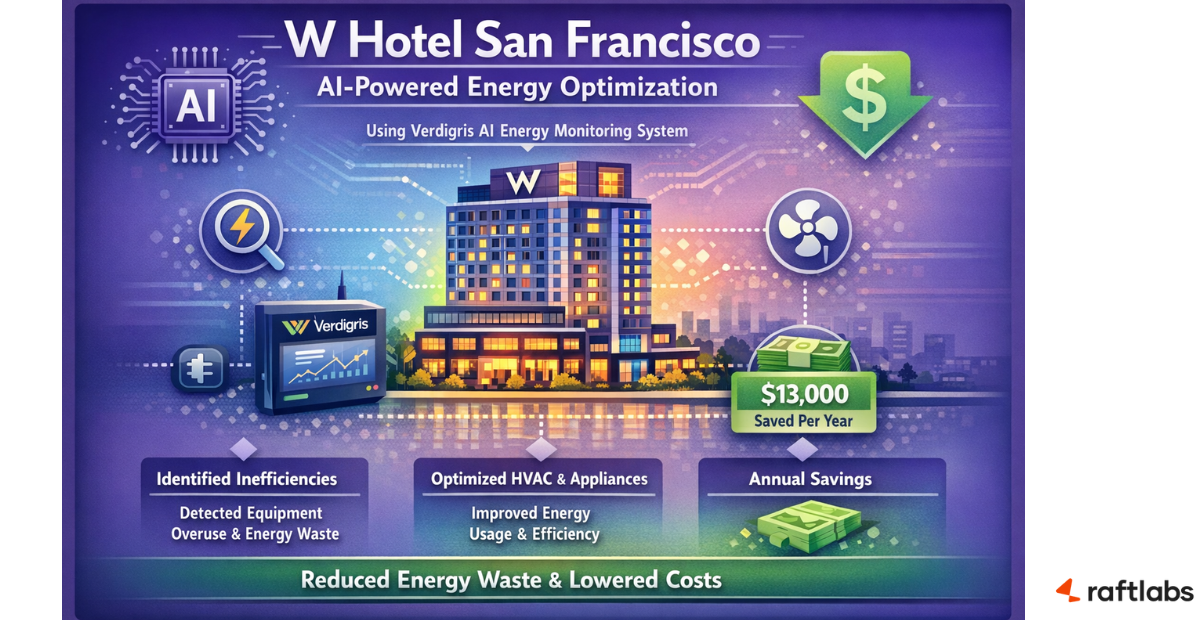
As AI becomes more sophisticated, sustainability in the hospitality industry will take center stage. AI agents will monitor and optimize energy usage, such as controlling lighting and room temperature based on occupancy. By reducing energy waste, these agents will help hotels cut down on their carbon footprint while saving on energy costs.
Additionally, AI will enhance operational efficiency by automating routine administrative tasks and enabling better resource allocation during peak seasons or special events. This optimization will reduce costs and increase profitability across the board.
5. Human-AI Collaboration
Despite all the advancements in AI, the human touch will remain at the heart of hospitality. AI agents will work alongside staff, taking on repetitive tasks and giving employees more time to focus on delivering exceptional, personalized service.
In the future, AI will act as a digital coworker, seamlessly integrating across systems to improve workflow efficiency and enable staff to engage with guests in more meaningful ways.
Also Read: Cost of building hotel booking application if your are planning to build booking application for your hotel business.
Why Choose Us for Building AI Agents for Your Business
Our AI agent development services combine strong technical expertise with a deep understanding of business needs to deliver agents that seamlessly integrate into your existing hospitality systems.
Here’s why you should choose us for your AI agent development:
Rapid Prototyping for Quick Results
We believe in starting fast and learning early. Instead of locking you into long development cycles, we start by delivering a working AI prototype within 1-2 weeks.
This allows you to see tangible results early, test the functionality, and refine the product before committing to full-scale development. It’s an approach that minimizes risk and maximizes clarity.
Comprehensive End-to-End Development
AI is just one part of the solution. We can develop AI agents, backend systems, frontend experiences (both web and mobile), and third-party integrations.
Your AI agent will not exist in isolation; it will seamlessly connect to your product and platform, ensuring a unified, scalable system that enhances your existing processes.
Collaborative Approach with Full Transparency
We take transparency seriously. Through agile practices, clear documentation, and consistent communication, you will always know exactly what we’re working on and why.
Our aim is to keep you in control and avoid vendor lock-in, ensuring the development process remains collaborative and fully aligned with your business objectives.
Scalable and Flexible Solutions
Whether you're deploying AI agents for a growing property or a global network of hotels, we design scalable solutions that grow with your business. From modular components to API-first systems, we ensure your AI agents are ready to handle future growth without needing costly rewrites or downtime.
Security and Data Integrity
We understand that your data is invaluable. That's why our AI agents are built with enterprise-grade security to protect your guests’ data. We follow strict compliance workflows to ensure that your AI agents meet regulatory standards and safeguard privacy, regardless of the industry you operate in.
24/7 Support Post-Launch
Our commitment to your success doesn’t end at deployment. We offer continuous monitoring, regular updates, and dedicated support to ensure your AI agents continue to evolve and meet the changing demands of your business.
We’re here to support you every step of the way, from the first prototype to future scaling.
Proven Track Record with Global Brands
We are trusted by market leaders like City Breaks Apartments, EventRaft, and Aldi. Our ability to deliver technically sound, business-aligned, and user-friendly AI solutions has earned us the trust of global brands.
This track record of success ensures that we can help you implement AI agents that deliver measurable impact.
Types of AI Agents We Develop
Here’s a breakdown of the different types of AI agents we build:
| AI Agent Type | Description |
|---|---|
| Customer Service Agents | Handle support 24/7, resolve FAQs, route tickets, and collect feedback across various channels. These agents enhance customer satisfaction by reducing response time without increasing headcount. |
| Task Automation Agents | Automate routine tasks like scheduling, sending reminders, and processing forms, ensuring smooth operations while reducing manual effort and delays. |
| Data Analysis & Insights Agents | Scan large datasets, generate summaries, and identify trends, helping teams make informed decisions quickly and efficiently without manual analysis. |
| Process Optimization Agents | Streamline workflows such as supply chain tracking and internal approvals, improving efficiency and minimizing bottlenecks across business processes. |
| Sales & Marketing Agents | Qualify leads, recommend content, and optimize ad campaigns in real-time, allowing teams to focus on high-potential opportunities and drive better campaign results. |
| Specialized Industry Agents | Custom-built for specific sectors like hospitality, travel, finance, or real estate, these agents cater to industry-specific needs such as appointment scheduling and data validation. |
| Custom-Function Agents | Developed from scratch to suit unique business workflows. Whether for internal training or a client-facing assistant, we craft solutions that meet your exact vision. |
Final Thoughts
As the hospitality industry evolves, the demand for smarter, more efficient solutions is greater than ever. With AI agents, hospitality businesses can meet guest expectations and even exceed them by offering seamless, customized experiences that traditional methods struggle to achieve.
As technology continues to reshape how businesses interact with their guests, AI is poised to play an essential role in driving this change.
We specialize in creating custom AI solutions tailored to your hospitality business needs. Whether you're looking to automate guest services or optimize your operations, we can help you implement scalable AI solutions that drive results.
Contact us today to explore how we can assist in your digital transformation journey.
Frequently Asked Questions
- An AI agent in hospitality is software that can understand goals, make decisions, and take actions across your hotel or property's systems, autonomously, without requiring human input for every step. Unlike a chatbot, which only responds to messages, an AI agent can check room availability, update a booking in the PMS, issue a digital key, trigger a housekeeping task, and confirm all of this with the guest as part of a single automated workflow.
- AI chatbots handle specific tasks like answering questions or providing basic assistance. AI agents, however, are more advanced and can manage multiple tasks across systems, such as automating bookings, optimizing pricing, and offering personalized services. They analyze data, make decisions, and act proactively, while chatbots are typically reactive.
- The cost of building AI agents depends on complexity, customization, and integration needs. Basic systems can start at a few thousand dollars, while more advanced, fully integrated solutions may cost several hundred thousand dollars.
- Development time varies based on complexity. Simple AI systems can take 6-8 weeks, while more advanced solutions may take 3-6 months to complete, including phases like prototyping, integration, and testing.
- Production-ready AI agents in hospitality applications integrate with Property Management Systems (PMS) for booking and room data, Revenue Management Systems (RMS) for pricing, Channel Managers for OTA inventory sync, CRM platforms for guest history and preferences, booking engines for direct reservations, and access control systems (such as Bluetooth lock management platforms) for keyless entry. The integrations required depend on the specific use case. A guest communication agent needs PMS and CRM access; a pricing agent needs RMS and channel manager access.
- AI agents can be safe for guest data when built with strong security measures. Compliance with regulations like GDPR, data encryption, and secure authentication are essential to protect guest information.
- Yes, small hotels can use AI agents to automate tasks like guest check-ins, reservations, and customer service. AI solutions are scalable and can be customized to suit the needs of hotels of any size.